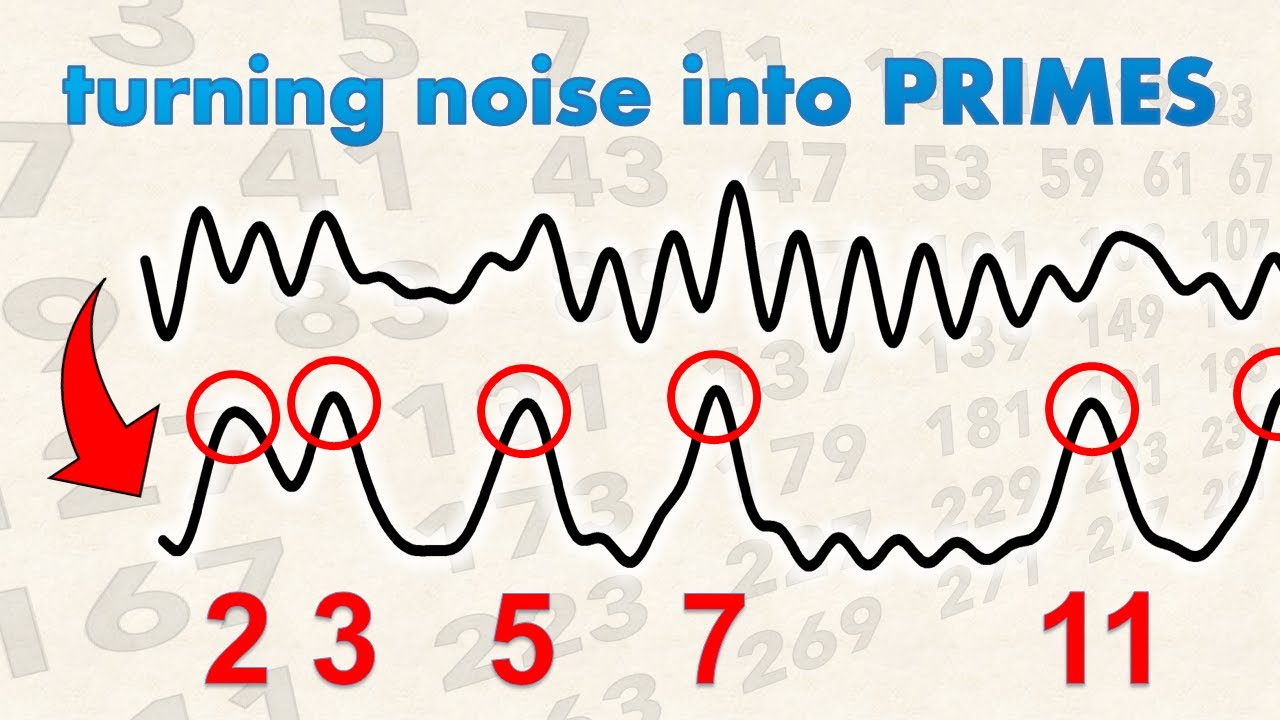
Solve one equation and earn a million dollars! We will explorer the secrets behind the Riemann Hypothesis - the most famous open problem in mathematics - and what it would tell us about prime numbers.
I should have mentioned one additional property, namely zeros are mirrored along the line 1/2, even though non of them are found and maybe even non of them even exist. This way, every zero not on the line would giva a harmonic with Re(s) greater than 1/2, thereby breaking the estimates for the prime counting function.
Results discussed / references
List of the 7 million-dollar Millenium Problems: https://en.wikipedia.org/wiki/Millennium_Prize_Problems
How to extend the Riemann zeta function: https://www.youtube.com/watch?v=sD0NjbwqlYw
Current best approximations for pi(x): https://www.sciencedirect.com/science/article/pii/S0022314X15001924 (Corollary 2)
"Implementation of Riemann’s Explicit Formula for Rational and Gaussian Primes in Sage": http://ism.uqam.ca/~ism/pdf/Hutama-scientific%20report.pdf
"Some Calculations Related to Riemann's Prime Number Formula": https://www.ams.org/journals/mcom/1970-24-112/S0025-5718-1970-0277489-3/S0025-5718-1970-0277489-3.pdf
"The Riemann hypothesis is true up to 3*10^12": https://arxiv.org/pdf/2004.09765.pdf
Consequences of different zero-free regions on the growth of |pi(x)-li(x)|: A.E. Ingham: The Distribution of Prime Numbers, Cambridge University Press
Scene from Big Bang Theory: S12E6 The Imitation Perturbation


0 Comments